English
 Deutsch
 Español
 Français
 Italiano
 日本語
日本語 Русский
 中文
中文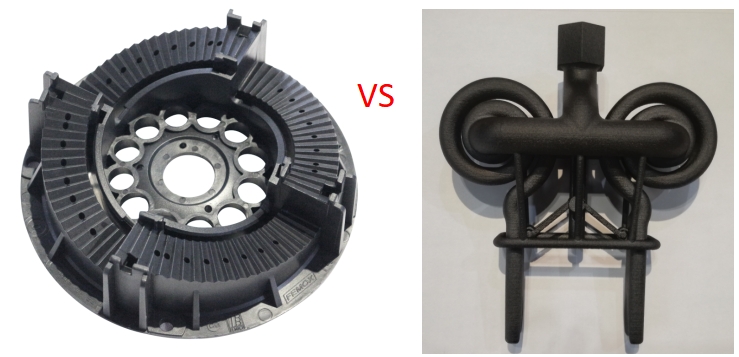
- Author
- 06 November 2025
Plastics Injection Molding vs. 3D Printing: Making the Right Choice for Your Project
A strategic comparison of cost, speed, and scalability to optimize your manufacturing ROI.
Introduction:
In recent years, 3D printing has gradually replaced injection molding in some batch applications. However, many readers are not sure how to choose between the two technologies in actual product production. Both methods offer unique advantages and considerations that need to be weighed when determining the optimal manufacturing approach for a given project.
1. ECONOMIC IMPACT: UPFRONT TOOLING VS. UNIT COSTS
Injection Molding: Injection molding typically requires upfront tooling costs, Even for the simplest product, the tooling cost starts at more than 2,000 US dollars. So when most products have not yet determined their sales volume or their designs are constantly changing, this is not a wise choice. The high tooling cost making it more suitable for high-volume production runs.
3D Printing: 3D printing eliminates the need for expensive tooling, making it a cost-effective option for low-volume production and customized designs. However, the costs per unit tend to be higher than injection molding for larger production quantities.
2. PRODUCTION TIMELINE: SPEED AND LEAD TIME TRADE-OFFS
Injection Molding: Once the molds are created, injection molding enables high-speed production runs, let’s take the phone case as an example, 5K pieces by one injection molding machine only takes 3-4 days even shorter. However, by 3D Printing, it takes at least 15-20 days by one 3D Printer. The high speed of injection molding making it ideal for large quantities. However, the initial setup and mold fabrication process may introduce lead times (20-30 days) before production can commence.
3D Printing: For prototyping & low-volume production, 3D printing offers quick turnaround times. It eliminates the need for tooling, allowing for rapid prototyping and faster iterations.
3. MATERIAL VERSATILITY: DIVERSITY AND FUNCTIONAL PERFORMANCE
Injection Molding: Injection molding offers a wide array of material options, including various plastics and elastomers. In addition, it can support metal insert (insert molding) and combined materials in one part (overmolding), providing versatility for different applications.
3D Printing: While 3D printing materials have expanded significantly in recent years, the range of available materials is still more limited compared to injection molding. So far, in terms of industrial and functional applications, the technologies that can replace injection molding for mass production are mainly FDM, SLS and MJF. However, advancements are being made to introduce new materials with improved properties.
4. QUALITY STANDARDS: SURFACE FINISHES AND AESTHETICS
Injection Molding: The surface finish achieved through injection molding is typically smooth and consistent. The mold used in injection molding is specially designed to impart a desired texture or finish on the molded part. Common surface finishes in injection molding include glossy, matte, textured, or patterned finishes. Injection molding can produce high-quality, detailed surface finishes that are suitable for a wide range of applications.
3D Printing: The surface finish achieved in 3D printing can vary significantly depending on the printing technology and the material used. In general, 3D printed objects tend to have visible layer lines or a slightly rough texture. The surface finish quality can be improved through post-processing techniques such as sanding, vaporfuse smoothing, polishing, or applying surface coatings. However, achieving the same level of smoothness and consistency as injection molding can be more challenging with 3D printing.
5. AGILE MANUFACTURING: DESIGN FLEXIBILITY AND ITERATION
Injection Molding: As you may be aware, the process of injection molding necessitates the creation of a pre-existing mold. Once the mold is finalized, only minor design modifications can be accommodated. Consequently, it is crucial to have confidence in your design before contemplating mass production via injection molding.
3D Printing: As no tooling involved, it allows the user to change the design at the middle way without losing any cost.
Technology Comparison Matrix
| Technology | Cost | Production Speed | Materials Selection | Surface Finishes | Design Flexible |
|---|---|---|---|---|---|
| Injection Molding | Low for large volume | High for large volume | Many | High | Low |
| 3D Printing | Low for low-volume | High for low-volume | Few | Low | High |
CONCLUSION
When deciding between injection molding and 3D printing, it’s crucial to evaluate factors such as cost, production speed, material selection, surface finishes and design flexible. Injection molding excels in high-volume production, high surface quality, and a broad material selection. On the other hand, 3D printing offers design freedom, rapid prototyping, and cost-effective low-volume production. Ultimately, the choice depends on the specific requirements of your project, and in some cases, a combination of both techniques may be the optimal solution.